
The short answer
Your garage door is almost certainly the weakest structural point on your house in a windstorm, and if it fails, the whole roof system is at risk. The fix is a combination of the right door, the right bracing, and the right maintenance habits kept up through the rest of this hurricane season. Here's why it matters and how to actually get it done.
Why the garage door takes the hit first
A garage door is the largest opening in most homes' exterior walls, and unlike a window or an exterior door, it's made of thin panels held together with hardware, not a solid slab. When wind hits a closed house, pressure builds up outside. If the garage door buckles or blows in, that pressure suddenly has a way inside the structure, and it pushes up and out against the roof from underneath. This is why so many wind-related roof failures actually start with a garage door failure. A door rated for the loads this area sees, installed correctly with the matching track and hardware, is what keeps that from happening.
What a failing door looks like before a storm ever hits
- Panels that flex or oil-can (visibly bow in and out) when you push on them by hand
- Tracks that aren't firmly bolted to the framing, or brackets with any play in them
- Rollers and hinges with surface rust, common on coastal homes exposed to salt air, which weakens the metal faster than inland installations
- A door that's been painted or patched over old dents, hiding where the panel metal has already thinned
- An opener with no manual lock-back or reinforced bracing, relying only on the motor to hold the door shut under pressure
Any one of these on its own might just mean a rattly door. Combined, they mean the door has very little reserve capacity left when wind loads spike during a storm.
What actually holds up in high wind
Reinforcement options, and their trade-offs
- Horizontal bracing kits bolted across the back of each panel add rigidity to an existing door for a modest cost. They work, but they only help as much as the door's existing frame and tracks can support. If the tracks or end hinges are already weak, bracing a thin panel won't fix the real problem.
- Impact-rated or wind-rated replacement doors are built with heavier gauge steel, reinforced struts, and track hardware designed for sustained pressure. This is a bigger upfront cost than a brace kit, but it's a one-time investment instead of a patch, and it typically comes with a tune-up to the opener and tracks at the same time.
- Opener upgrades matter too. A newer opener with a proper lock mechanism keeps the door engaged under pressure instead of relying on friction alone, which older units often do.
Maintenance that actually prevents failure
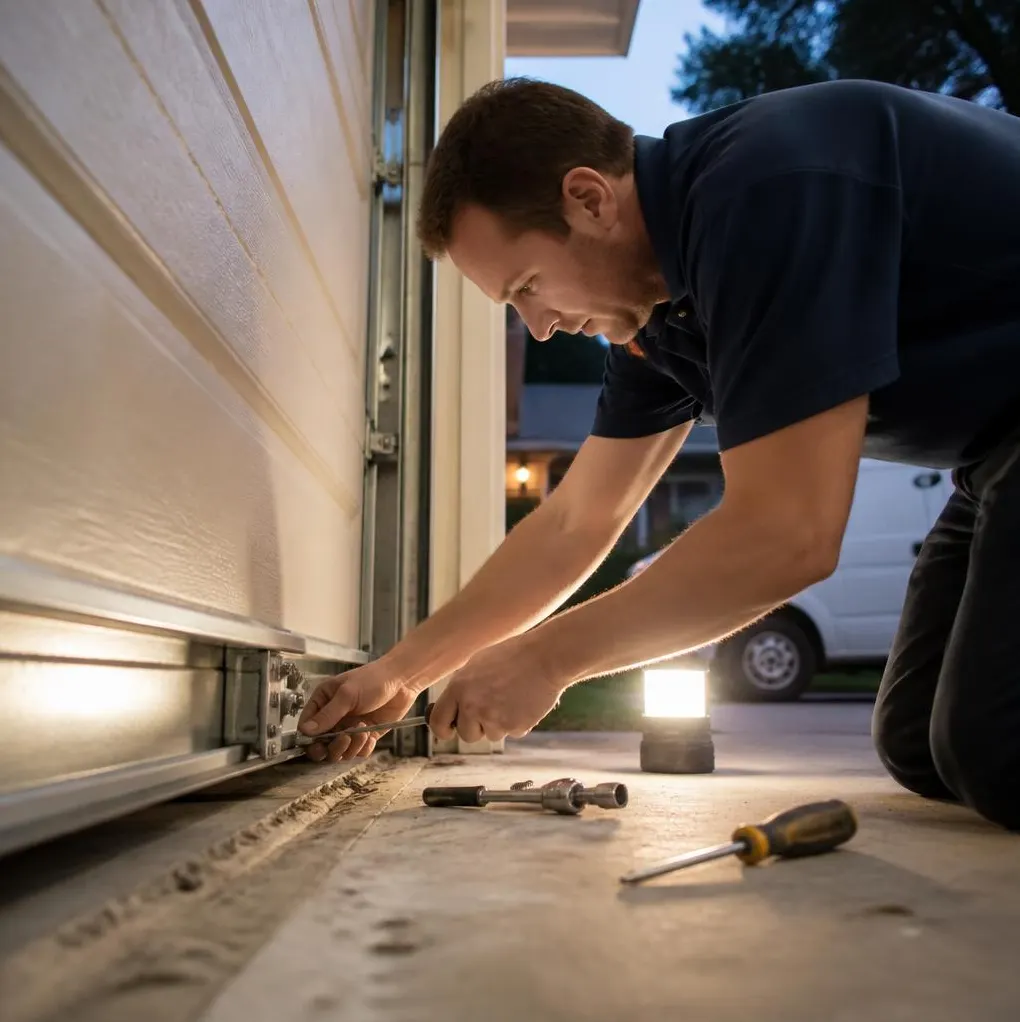
- Check and tighten every track bolt and hinge screw twice a year; vibration from storms and daily use loosens them over time
- Lubricate rollers and hinges regularly with a product rated for coastal/salt-air exposure, not a generic household oil that washes out quickly in humidity
- Replace any roller, hinge, or bracket showing rust pitting rather than just surface discoloration, since pitted metal has already lost strength
- Test the balance of the door by disconnecting the opener and lifting it by hand; it should hold steady at waist height. If it drifts up or crashes down, the springs are compensating incorrectly and won't perform reliably under storm stress
- Clear tracks of salt residue and grit after heavy wind events, since buildup causes binding that strains the opener and hardware
None of this is complicated, but it's the kind of thing that gets skipped until something fails mid-storm, which is exactly the wrong time to find out.
When to call Key Colony Beach Door & Opener
If your door flexes under hand pressure, if hardware shows real rust rather than surface spotting, or if you're not sure your current door meets wind-load standards for this area, that's worth a professional look before the next system comes through. We handle garage door maintenance & tune-ups to catch loose hardware and worn rollers early, and garage door panel replacement when a door's structure is sound but specific panels have thinned or warped from age and moisture. For homes that need a full upgrade, we also handle complete garage door installation with hardware matched to the loads this area actually sees.
If you're in Key Colony Beach, Marathon, Duck Key, or anywhere else in the Keys and want your garage door checked before the next storm, call Key Colony Beach Door & Opener today.